
The Missing Links in Environmental Restoration
Communities across Kenya are planting trees. They are also burning them. Not because they are careless but because they have limited alternatives for cooking fuel. Women and girls in many rural areas spend up to two hours each day collecting firewood. Kenya loses approximately 50,000 hectares of forest annually to biomass energy demand. Meanwhile, more than 80% of low-income households depend on charcoal or firewood to cook.
Energy is only part of the story. Seedlings can die in dry seasons because no one planned for water before planting. Soils can degrade because farming practices strip rather than rebuild them. And communities can abandon restoration sites because stewardship offers them no income. Four gaps: dependence on biomass cooking fuel, inadequate water management, unsustainable farming practices and meagre livelihoods can combine to undermine what communities are trying to restore.
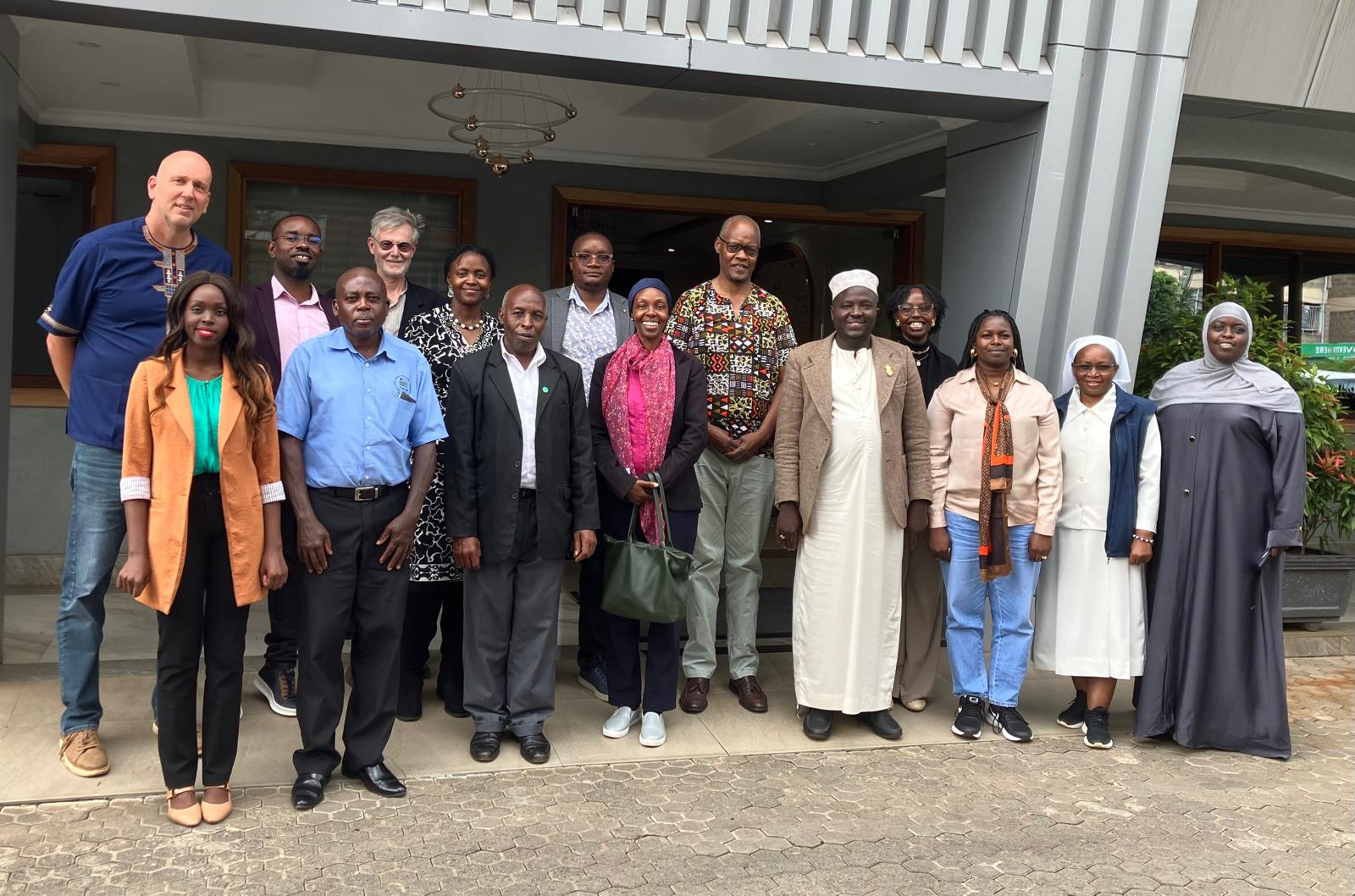
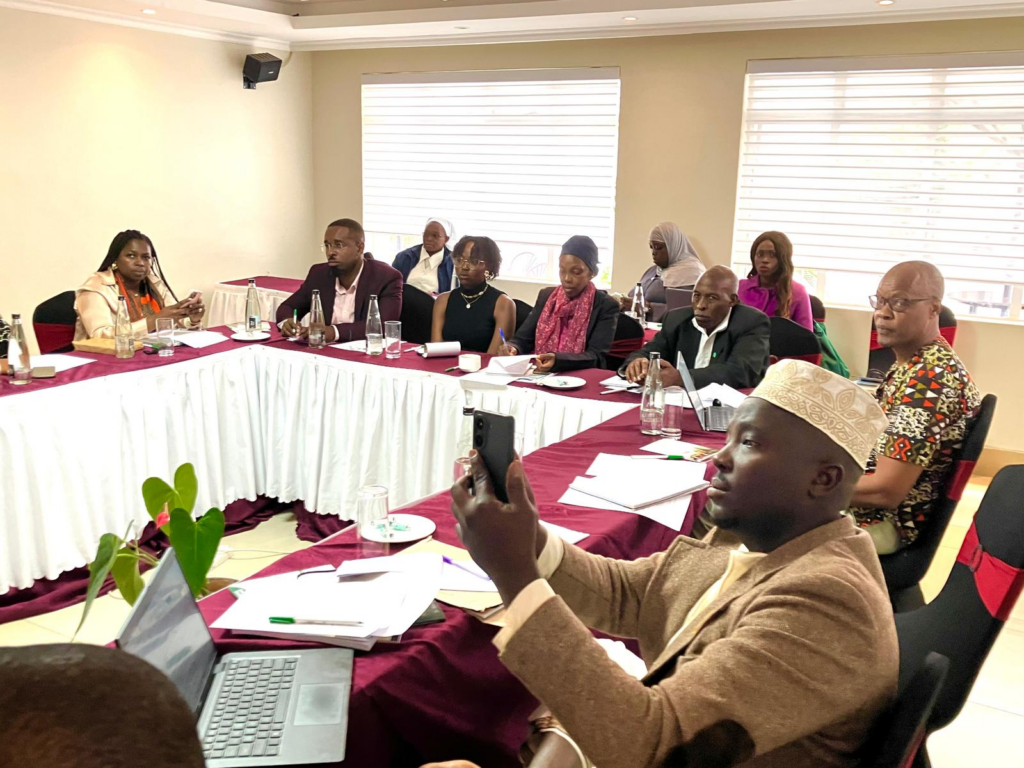
On 28 April 2026, OikoDiplomatique convened a roundtable to explore how to fill in the missing links in environmental restoration. Experts in water management, clean cooking energy, conservation agriculture, solar water purification and community forestry sat together with faith leaders. We examined not only individual solutions but how those solutions connect. Restoration that encompasses them all is more likely to hold.
Why Holistic Restoration Is Not Optional
OikoDiplomatique has been pioneering faith-based land restoration and conservation in Kenya for several years. Through partnerships at community, county, national, and international levels, it has supported tree growing and natural regeneration across Kakamega, Baringo, Isiolo, and Kilifi Counties. While the results are meaningful, communities keeps surfacing the same challenges.
Water and Soil: Seedling survival in dry seasons can collapse without prior investment in soil moisture and runoff capture. Degraded land converts rainfall into runoff, erosion, and downstream loss rather than into groundwater recharge. Tree planting failure is often due to lack of water.
Energy: It is difficult to protect trees adequately if you depend on them for fuel. Protecting them more in one area may result in more depletion in another. Without addressing cooking energy, restoration strategies are incomplete.
Livelihoods: Restoration sites that provide no economic incentive cannot realistically be maintained. Stewardship requires both more than moral conviction.
The roundtable’s thesis put it plainly: Creation is a Whole, and faith-based restoration needs to be holistic if it is to have lasting impact.
What Brought the Partners Together
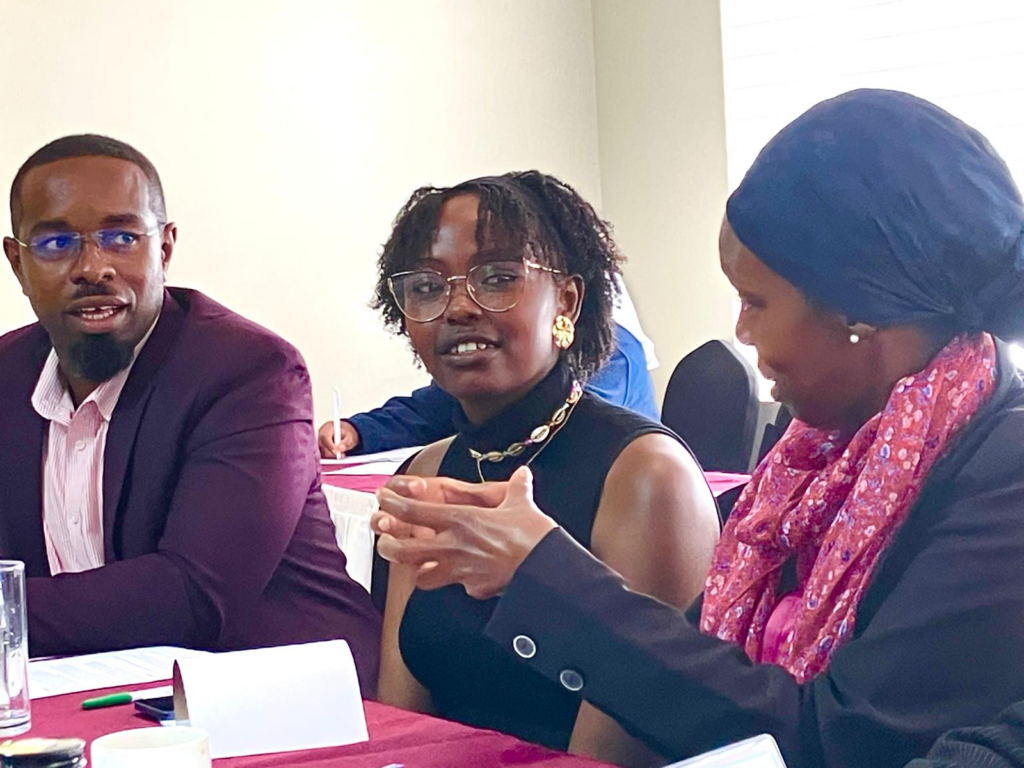
OikoDiplomatique chose the roundtable participants for complementarity. Each addressed a gap the others could not. What united them was a shared diagnosis: restoration work in Kenya has been too siloed. Faith communities, who hold deep, permanent presence in rural Kenya, rarely receive the integrated technical support they need to connect these threads. The roundtable was an attempt to stir lasting systemic change and impact by fostering deeper levels of inter-sectoral understanding and collaboration.
Partner Contributions
OikoDiplomatique — Convener
OikoDiplomatique did not just host the day. We brought a tested model of faith-based engagement developed across Kenya’s ecologically and culturally diverse landscapes. Our approach positions faith institutions as active implementers of restoration; responsible for water management, tree growing, and natural regeneration, including on church land, schools, farms, and recreational parks. Faith leaders carry moral authority that is difficult to replicate. Faith institutions remain in communities long after development projects close. These two facts make faith communities essential partners in any restoration strategy that aims to last. Learn more about OikoDiplomatique’s work.
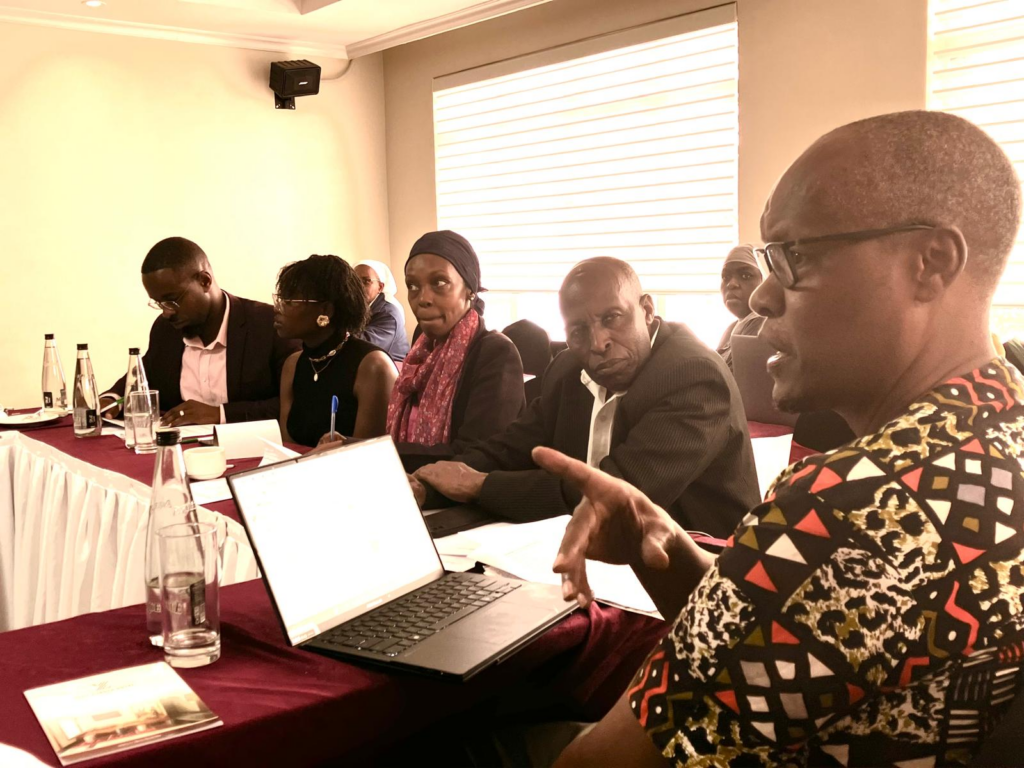
Mr Simon Thuo: Water Management and Integrated Land Restoration
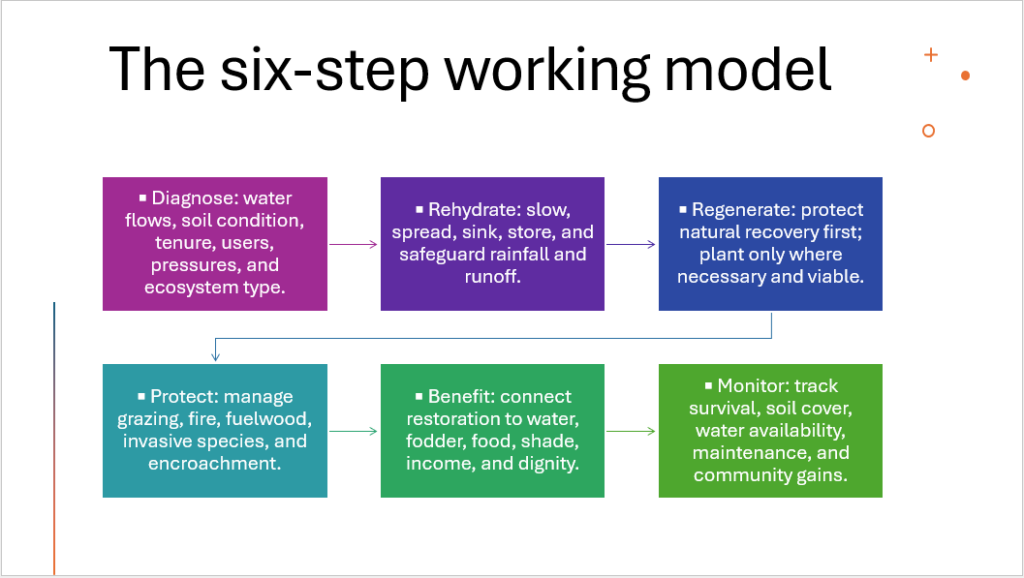
Mr Simon Thuo, a water management expert, framed the central challenge of restoration with a single proposition: water comes before trees. Degraded landscapes must be rehydrated before they are revegetated. Water determines soil moisture, seedling survival, grass recovery, and biodiversity return. Yet most restoration programs in Kenya still lead with planting targets rather than water plans. Mr Thuo presented a six-step working model: diagnose, rehydrate, regenerate, protect, benefit, monitor, and drew clear distinctions between OikoDiplomatique’s four target counties. Kakamega requires attention to forest-edge pressure and riparian protection. Baringo demands a focus on erosion control and runoff harvesting. Isiolo calls for dryland water security and Farmer-Managed Natural Regeneration (FMNR). Kilifi faces coastal forest pressure alongside high fuelwood demand.
His practical menu of water-harvesting tools, roof collection at churches and mosques, contour bunds, zai pits, check dams, and sand dams, gave participants a concrete starting point. He issued a direct three-part challenge to the room: (1) prepare a water plan before a planting plan; (2) stop celebrating launch-day planting numbers; (3) start tracking 3-, 6-, 12-, and 24-month survival rates. Contact Simon Thuo(tbc)
Silver Tech Agencies Ltd
Efficient Cooking Technologies
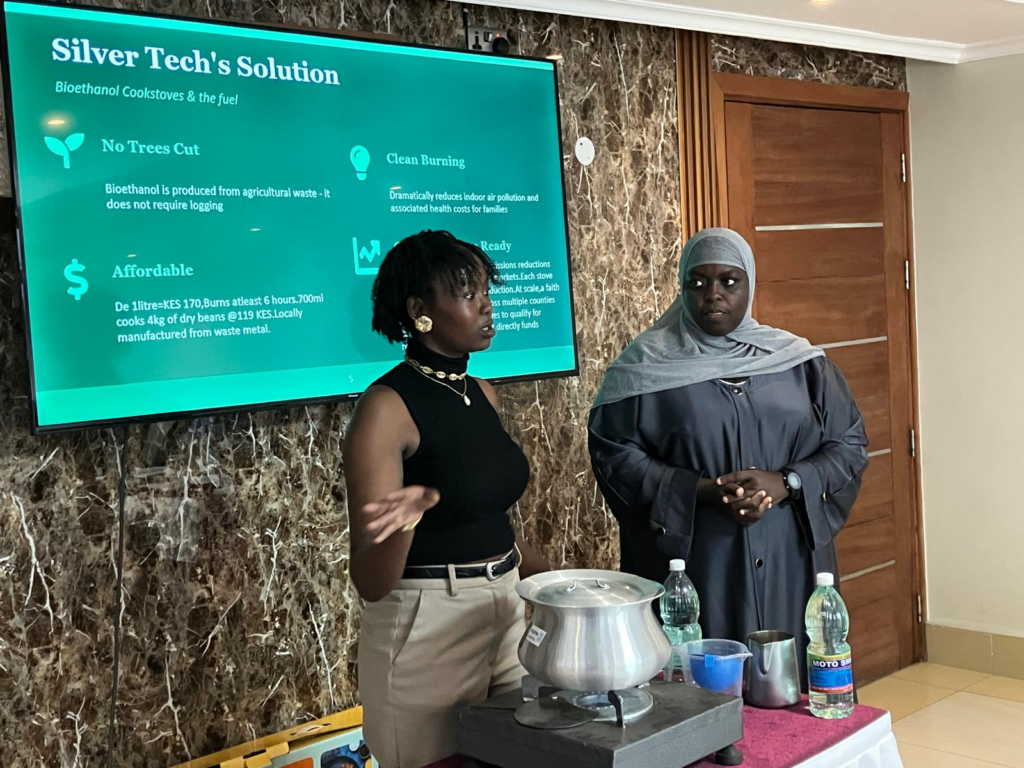
Ms. Caroline Kimathi named the energy paradox mentioned earlier in the workshop and then offered a concrete solution: bioethanol cookstoves, locally made from waste metal, fuelled by agricultural residue rather than trees. The economics are accessible. One litre of bioethanol costs about KES 170 and burns for at least six hours. 700ml cooks four kilograms of dry beans at KES 119. Each household that switches from charcoal to bioethanol reduces pressure on restored land, cuts indoor air pollution, and frees women from the daily firewood burden. That freed time becomes available for livelihood activities, community participation, and economic agency. The stoves also generate verifiable carbon emissions reductions. Faith communities that distribute stoves across multiple counties can aggregate enough units to qualify for carbon credits, revenue that can feed directly back into restoration programs. Women and youth can serve as community-level distributors and service agents, turning adoption into income. Learn more about Silver Tech Agencies Ltd(Tbc).
Juddy Wanja, Mwangaza Light Limited
Alternative Energy as a Catalyst for Creation Care
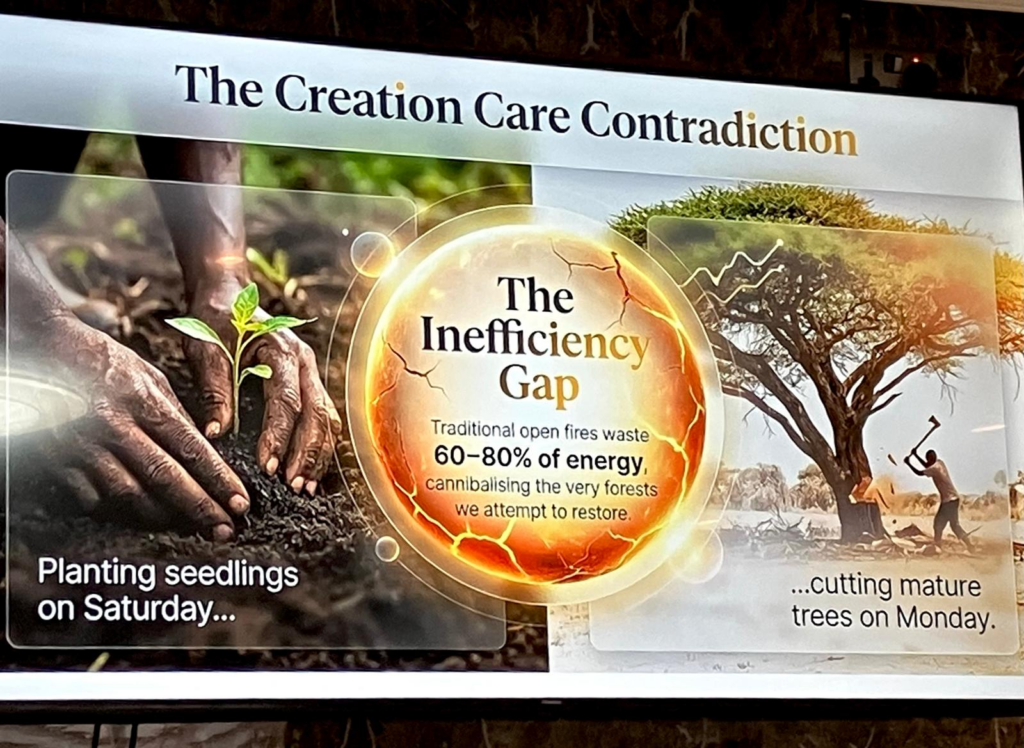
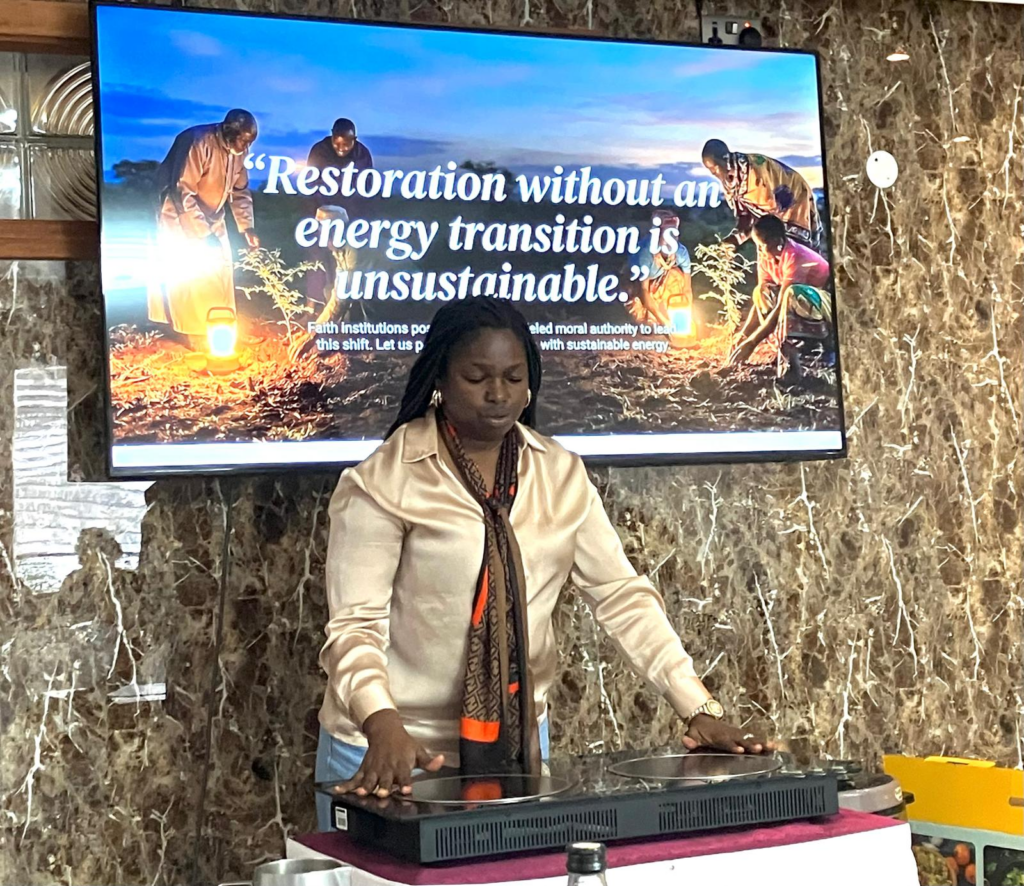
Juddy Wanja of Mwangaza Light Limited opened with a stark data point: traditional open fires waste 60–80% of the energy they generate. Mwangaza Light’s response is an integrated ecosystem approach built on three linked steps: Teach Green, Go Green, and Grow Green. The first embeds Creation care into community messaging through faith networks, building the moral case for cleaner energy. The second delivers it, conducting facility energy audits and distributing clean energy technology to the last mile, where it is needed most. The third reinvests the gains: women trained as community energy agents, with profits and saved time channelled directly into tree nurseries and climate-resilient agribusinesses. The numbers are concrete. Household firewood use drops by 30–60%. Biomass institutional cookstoves achieve up to 72% fuel savings. Solar lighting unlocks KES 500–1,000 per month in direct household savings. Women freed from 20-plus hours of weekly fuel collection retain income and gain new enterprise opportunities through energy distribution micro-businesses. Mwangaza Light’s proposition is that faith institutions are not just a distribution channel for clean energy, they are the behaviour-change engine that makes adoption stick, translating technological upgrades into communal and spiritual mandates. Learn more about Mwangaza Light Limited.
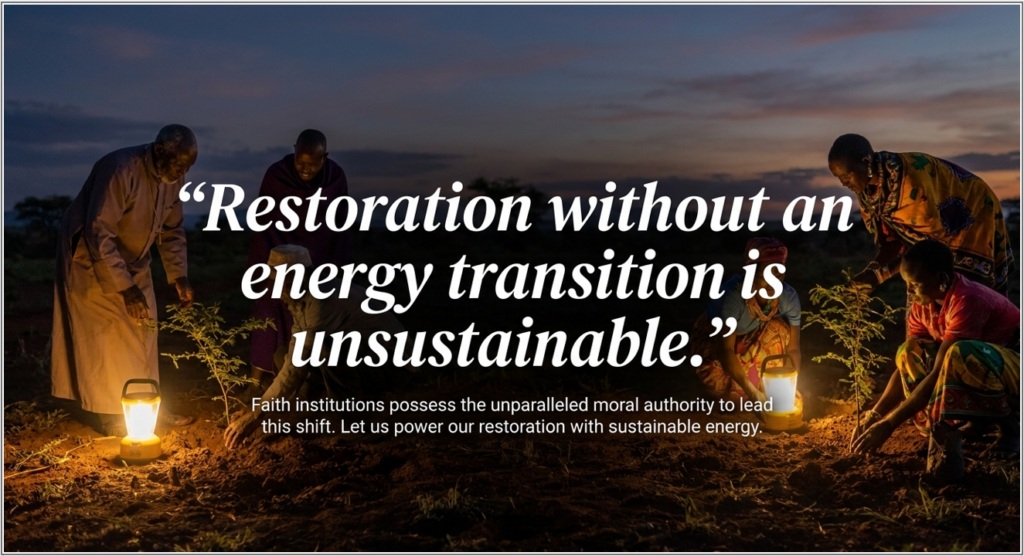
Mr Stephan Lutz, MWENDO Consulting
Conservation Agriculture for Faith Communities
Stephan Lutz brought an agroecology perspective to the roundtable. Conservation Agriculture (CA) rests on three principles: minimise tillage, maximise soil cover, and practise crop associations and rotations. In Mr Lutz’s field experience across Kenya, CA consistently outperforms conventional farming in erratic rainfall seasons. It produces better-quality crops, fetches stronger market prices, and saves farmers enough time to pursue additional income. CA is also restorative in its own right. Combined with green manure-covered crops such as lablab(Njahi), it rebuilds soil fertility and structure over time. It uses local resources. And it is already framed for faith audiences through approaches such as Farming God’s Way and Farming Allah’s Way, making it theologically as well as agronomically legible.
The main obstacles, including behavior change around tillage practices, competition for mulch material between crops and livestock, and limited technical support, are not unconquerable. They are exactly the kind of challenges that trusted, long-term extension presence can address. Faith institutions are well placed to provide that presence. Stephan Lutz can be found on LinkedIn.
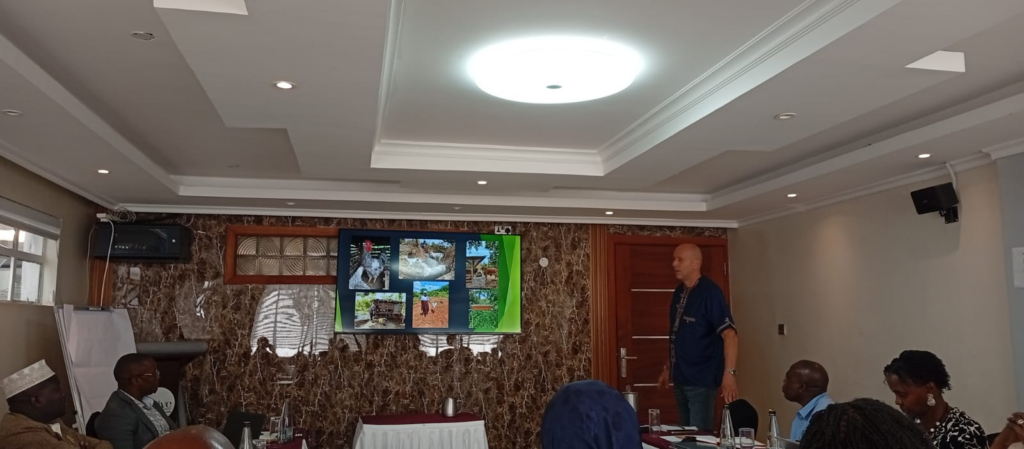
Solvatten
Solar Water Purification
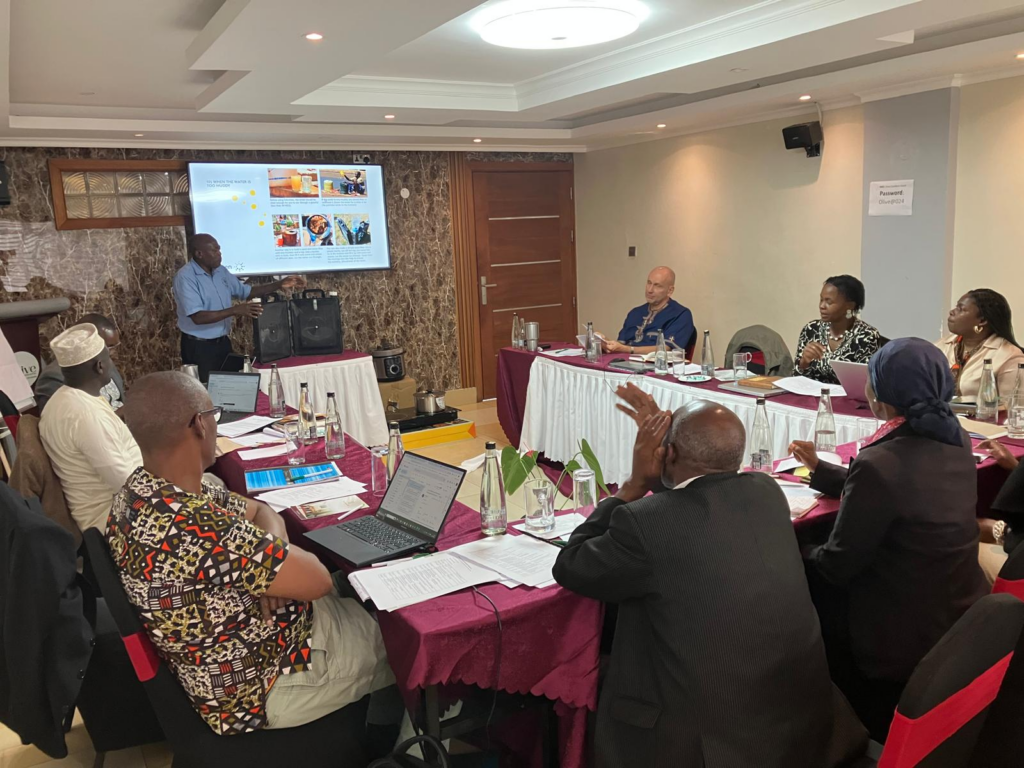
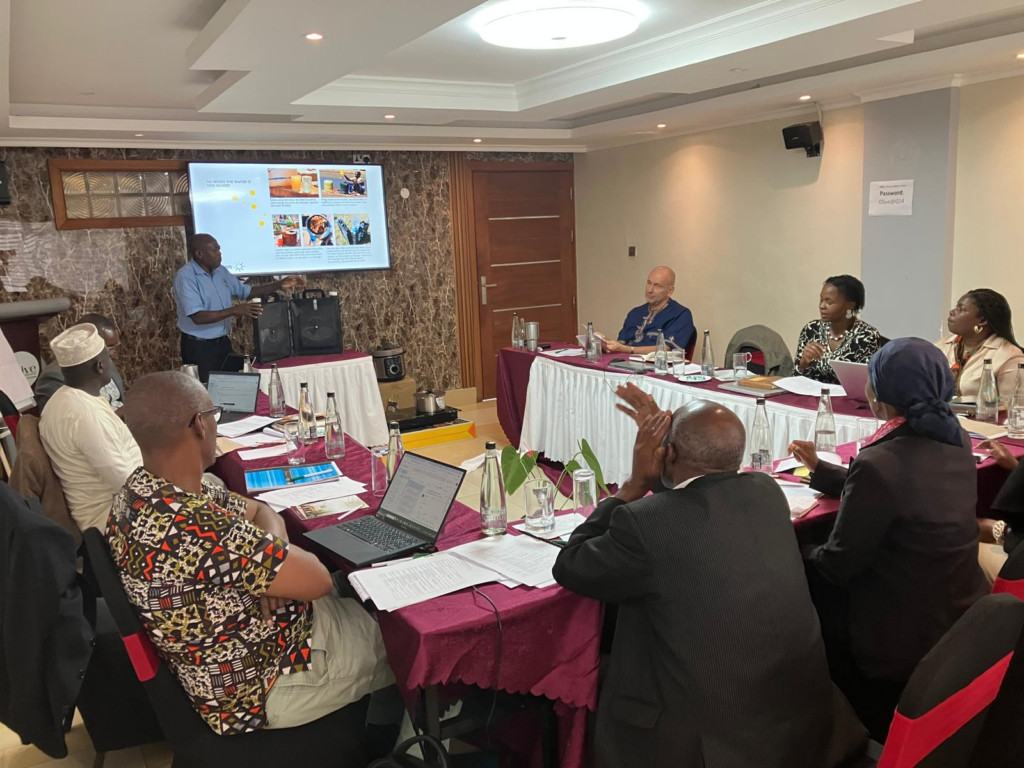
Mr Stephen Mutunga of the Eastern Community Development Programme CBO in eastern Kenya gave a practical demonstration of how the Solvatten water-purifying device works. Then he and Nathan Nkonge of Child Fund engaged in a question and answer session about its use. Discussion ranged from the efficacy of the device; its uses in different contexts, from pastoralist households to rural clinics and hair salons; how long it takes to work in different weather conditions, how much it costs, and the levels of uptake across Kenya.
OikoDiplomatique concluded that the Solvatten device could be useful for many of our faith-based partners in the arid and semi-arid (ASAL) counties of Kenya, who live and work amongst communities where accessing clean drinking water is a challenge. We agreed to test the device ourselves in Kajiado County and then potentially to pilot some kits with churches, mosques and faith-based CBOs in Kajiado, Isiolo, Baringo and Kilifi Counties. Learn more about Solvatten kits here.
Key Insights from the Day
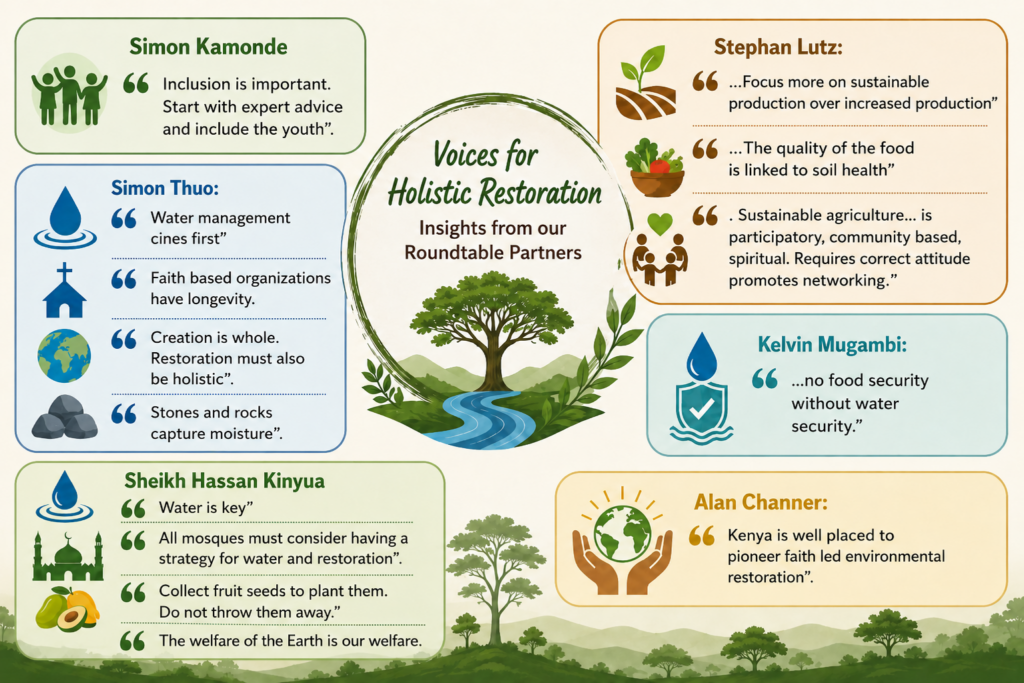
Several themes ran across all the presentations and participant discussions. They point toward a shared theory of change. The system, not the sector. Every presenter described their intervention as one node in a larger whole. Water without soil cover may not infiltrate. Soil cover without reduced energy demand can be undermined by ongoing firewood extraction. Clean energy without income opportunities may lack community buy-in. Income opportunities without water security can collapse in drought. No single solution is sufficient. Integration is key.
Faith institutions can serve as long-term implementers. Faith communities are not merely ceremonial endorsers of restoration campaigns. They are long-term stewards with institutional land, trusted leadership, networks, women’s groups, youth ministries, and weekly congregations, that function as ready-made channels for demonstration, accountability, and sustained behaviour change.
Women and girls are often at the centre. The firewood burden falls on women and girls. Indoor air pollution harms women and young children most. Time freed from fuel collection becomes time for education, enterprise, and leadership. Every solution presented, bioethanol stoves, conservation agriculture, solar water purification, water storage, names women as primary beneficiaries and primary agents of change.
Both Silver Tech and Solvatten noted that their technologies generate emissions reductions verifiable under voluntary carbon market standards. At sufficient scale, achievable when a faith network distributes across multiple counties, these reductions can be aggregated into qualifying carbon projects. The revenues can potentially flow back into restoration. Faith networks are well positioned to reach that scale. Nevertheless, carbon finance is complex and carbon finance projects are often fragile. The roundtable noted the unfortunate demise of the pioneering KOKO bioethanol scheme because of challenges around carbon credit policies and regulations.
Restoration with trees should be about survival rates, not planting rates. This caution was consistent across the water and agriculture presentations. Rather than counting trees planted, Kenya should count trees alive at 24 months, soil cover at six months, infiltration rates at twelve months, and community benefit at every stage. The shift represents the difference between a mere planting drive and actual restoration.
What Comes Next
Several concrete directions emerged.
Piloting integrated restoration: An immediate opportunity is for faith organisations in Baringo and Isiolo to integrate farmer-managed natural regeneration, clean cooking, water harvesting, conservation agriculture, and safe water access into a single. An integrated pilot will generate learning that the wider network can apply.
A technical checklist for actors in land restoration: Mr Simon Thuo asked what minimum technical checklist every faith institution should complete before beginning restoration. That checklist covering water diagnosis, site assessment, maintenance responsibilities, and survival monitoring. It is a practical deliverable that can be developed and distributed.
Carbon credit aggregation: The carbon finance thread deserves careful exploration. A faith network operating across multiple counties may already have the geographic spread needed to aggregate stove and water purifier deployments into a qualifying carbon project.
Youth-led monitoring: Faith youth ministries are an underused resource. Survival tracking, photographic site documentation, and community water availability monitoring are all within reach without complex reporting systems. Linking youth engagement to measurable restoration outcomes builds both capacity and accountability.
All partners at the roundtable expressed openness to continued collaboration. The conversation at the roundtable discussion now continues in the field, in faith communities, and across the country.
A Closing Reflection
One phrase came up repeatedly on 28 April: Creation is a whole. It is a theological statement. At this roundtable, it also functioned as a practical one.
Faith communities understand wholeness. The roundtable offered tools to act on that understanding: to turn prayer for rain into a water-harvesting plan, to turn care for Creation into soil that improves year by year, to turn the conviction that the land is entrusted to us into a cooking fire that does not cost a tree. Equipping faith communities with water plans, clean stoves, better farming practices, and safe water will empower and sustain restoration in the years ahead.
Photo credits: Alan Channer